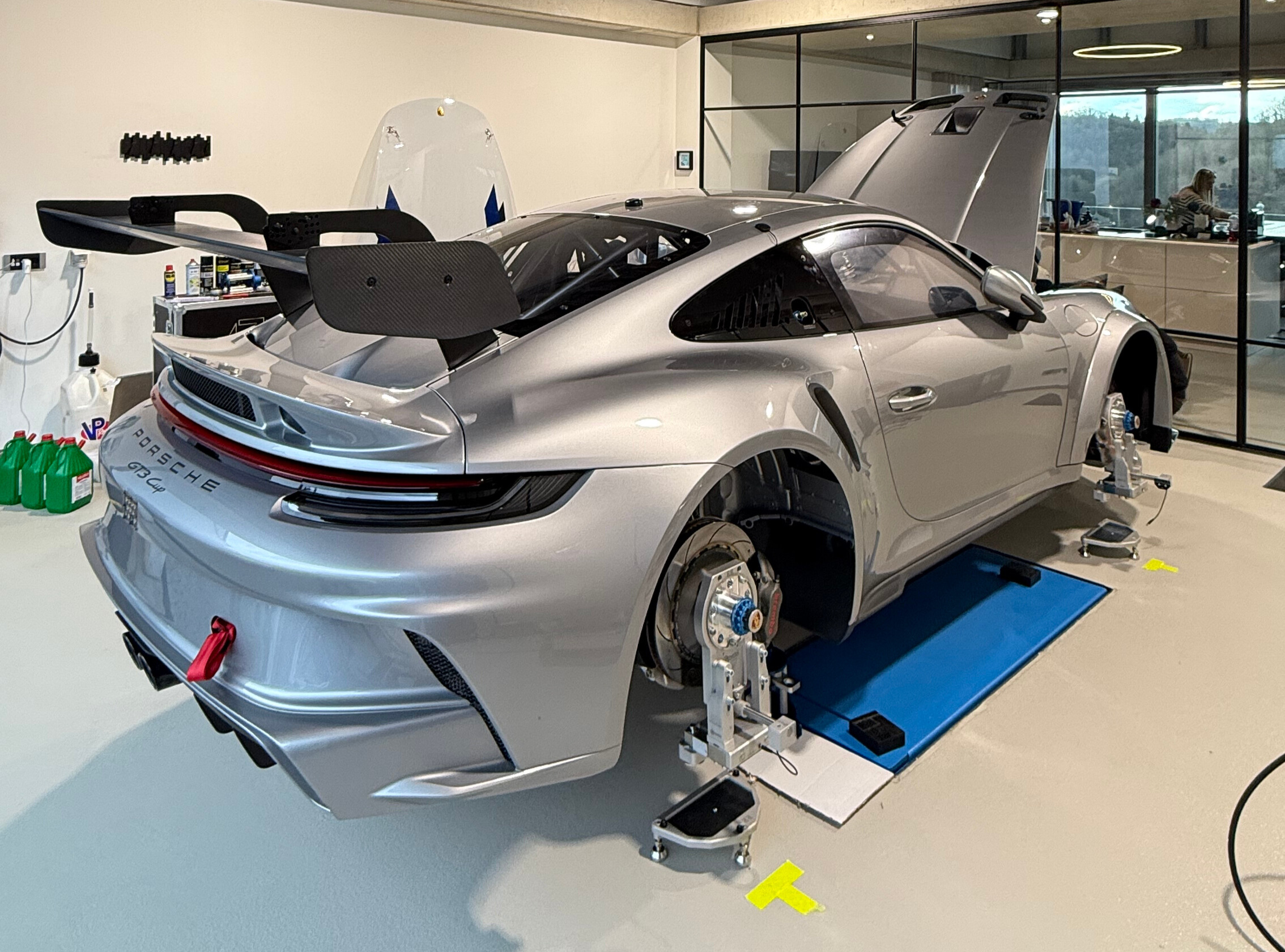
Pre-season is crunch time. Whether you’re prepping a dedicated race car, a time attack build, or a serious track day machine, there’s a checklist a mile long — and somewhere near the top, suspension alignment needs to sit. Not as an afterthought. Not something you eyeball in the paddock five minutes before the session. Done properly, with the right tools, hub stand alignment is one of the highest-leverage things you can do to unlock a car’s true potential before the season begins.
This guide walks through why hub stands have become the go-to method for precise wheel alignment in motorsport workshops, how to use them effectively, what measurements actually matter, and how to choose the right setup for your application — whether you’re running a regional club event or a professional series.
What Are Hub Stands and How Do They Work?
Hub stands are alignment tools designed to mount directly onto a vehicle’s wheel hub — referencing the same hub interface used by the wheel, with the correct adapter for your configuration. Once the wheels are removed, hub stands take their place, effectively simulating the wheel’s position in space without the tyre getting in the way of your measurements.
This is the core advantage: direct hub contact eliminates the variables introduced by both the tyre and the rim. Tyre pressure differences, sidewall deformation, uneven wear, and rim runout all create measurement noise in traditional string or lift-based alignment setups — and any one of them can give you a false reading that leads to a bad setup. Hub stands eliminate that category of error at the source.
In practice, the workflow is straightforward:
- Remove the wheels
- Attach the hub stands to the existing bolt pattern or central locking point
- Take your measurements — toe, camber, caster, ride height and corner weight — with far greater precision than you’d get with the wheels on
For race engineers and workshop technicians, this translates into faster setup sessions and more repeatable data. Once you’ve set a car up with hub stands, you can return to the exact same configuration in the next session by replicating the measurements — no guesswork, no drift between events.
NP Parts hub stands are machined from 6082-T6 aluminium, keeping them light and rigid, with a range of adapters to suit most race, track-day, and performance workshop platforms. Whether your car uses a central locking hub (common in single-seaters and GT cars) or a standard bolt-pattern wheel (5-stud road car conversions, touring cars, etc.), there’s a configuration that works.
Why Pre-Season Alignment Matters More Than Mid-Season Adjustments
There’s a temptation to treat alignment as reactive — something you adjust after a problem appears. The car pushes wide under braking, or feels nervous on corner entry, so you make a change. That’s firefighting, not engineering.
Pre-season alignment is fundamentally different. It’s your baseline. Everything you learn about the car during the season is relative to that baseline setup. If it’s wrong, your data is wrong, your driver feedback is wrong, and your adjustments are compounding an error rather than refining a good foundation.
Specifically, getting race car setup right before the first round means:
- Consistent tyre wear from lap one, rather than burning through a set before your setup is dialled in
- Accurate data logging interpretation — suspension travel, lateral g, and understeer/oversteer metrics all depend on correct geometry
- Time saved at events — a car that leaves the workshop correctly set up needs tweaks, not rebuilds, between sessions
- Driver confidence — there’s a measurable difference in driver performance when a car behaves predictably from the moment they leave the pit lane
Pre-season is also when you have the most time. In the workshop, without the pressure of a session in 45 minutes, you can be methodical. You can check and recheck. Hub stands make that thoroughness one of the most precise and repeatable portable methods available.
Toe, Camber, Caster: What You’re Actually Measuring and Why It Matters
A hub-stand-based setup system — whether that’s the NP Pro or Elite package, or hub stands paired with appropriate add-ons — gives you access to the four critical alignment parameters. Understanding what each one does helps prioritise where to spend your attention.
Toe
Toe describes whether the front of the tyre points inward (toe-in) or outward (toe-out) relative to the car’s centreline. It has a massive influence on straight-line stability, turn-in response, and tyre wear.
- Toe-in (front axle): adds stability, reduces turn-in aggressiveness — often used in cars prone to oversteer or on high-speed circuits
- Toe-out (front axle): sharpens initial turn-in — common in time attack cars and short circuit racers
- Rear toe settings affect rear stability significantly; even small changes (fractions of a degree) can transform how a car rotates through medium and high-speed corners
With a laser-based hub stand system, toe is measured using projected laser lines referenced to a central datum — precise, repeatable, and immune to the flex and guesswork of mechanical toe plates.
Camber
Camber is the angle of the tyre relative to vertical when viewed from the front. Negative camber (top of the tyre leaning inward) is nearly universal in motorsport because it keeps a greater portion of the contact patch loaded during cornering.
The right amount depends on tyre compound, suspension geometry, and track surface. Over-cambering destroys the inside shoulder in a straight line; under-cambering leaves performance on the table in corners. Getting it right — and getting it symmetrical side-to-side — requires measurement accuracy better than 0.1°.
In the NP Lite and Pro packages, camber is measured using a dual-axis digital angle reader included in the kit. The Pro package extends this to caster measurement as well. The Elite system goes further, with camber measurement built directly into the hub stand at 0.03° resolution, requiring no separate gauge and making the entire camber measurement process significantly more efficient.
Caster
Caster is the angle of the steering axis relative to vertical, viewed from the side. It affects steering weight, self-centring behaviour, and camber gain through steering lock. More caster generally means more high-speed stability and better feedback, at the cost of heavier steering.
Caster is harder to measure than toe or camber and is often skipped in basic setups. Both the Pro and Elite packages include a dual-axis digital angle reader for caster measurement. Caster is derived through a steering sweep procedure — readings are taken at defined lock angles and compared — but with the right tool, the process is clean and repeatable without needing additional equipment.
Ride Height
Ride height affects aerodynamic balance (critical on cars with any downforce), centre of gravity, and suspension geometry. Changes of just a few millimetres can shift a car’s handling balance noticeably.
Accurate toe camber adjustment at the wrong ride height is wasted effort. Hub stands, combined with a laser levelling tool and tape measure — including in the Elite system — let you confirm you’re measuring at the correct static ride height before you log any other data.
Choosing the Right Hub Stand System: From Laser Basics to Full Elite Setups
Not every application needs the same level of kit. Here’s how to think through the decision.
Entry-Level: NP Lite Hub Stands
The Lite system is the starting point — hub stands with magnetic angle plates for camber and a straightforward measurement workflow covering toe and camber. This is the right tool for club racers, track day enthusiasts running modified road cars, and workshops that want precision without committing to a full data system. It’s faster than traditional alignment rigs, more repeatable than manual methods, and portable enough to travel to events. Setup time from wheels-off to first measurement is measured in minutes.
Mid-Level: NP Pro Car Setup Package (Laser)
The Pro package bundles the hub stands with the laser kit, dual-axis digital angle reader, levelling plates, and levelling tool. Key features include adjustable height — allowing you to replicate the exact tyre diameter of your setup — and adjustable contact offset, which replicates the suspension load and geometry you’d have with wheels fitted. For teams running multiple cars, or workshops servicing clients with varied platforms, the integrated laser system improves accuracy and consistency — the Pro Laser Alignment System handles toe measurement, while the dual-axis reader covers camber and caster without needing to source separate gauges.
Elite System: Full Data Integration
The Elite system is for teams where setup data is an asset, not just a procedure. It adds:
- Corner weight measurement via Bluetooth-connected scales with 0.1% accuracy — in the Elite system, corner-weight readings are not affected by base levelling plate position — provided the setup procedure is followed correctly, including platform levelling and proper settling
- Camber built into the hub stand at 0.03° resolution, eliminating the need for a separate gauge
- Toe measurement via the Elite Laser Alignment System
- Caster via dual-axis digital angle reader
- Ride height via laser levelling tool and measuring tape
Corner weight measurement is the capability that separates the Elite system from everything below it. Getting weight distribution correct — front-to-rear and left-to-right — is fundamental to consistent handling. Incorrect cross-weight or side-to-side distribution can create handling asymmetry even when toe and camber are correct — a car that’s geometrically sound but poorly balanced will still punish the driver. The Bluetooth-connected scales feed data directly to your logging system, giving you a permanent record of the setup that’s easy to replicate at the next event.
Compatibility Note
NP Parts hub stands are compatible with a wide range of motorsport and performance vehicles. The only variable is the adapter required — cars with central locking hubs need a different interface than cars with standard bolt patterns. Additional centre adapters are available to cover both configurations, so if your workshop services multiple platforms, a single set of hub stands can cover the entire fleet.
FAQ
Q: Can hub stands be used on road cars, or are they only for dedicated race cars?
A: Hub stands work on any car that allows the wheels to be removed — which means essentially every car. Track day entrants running modified road cars, time attack builds on standard platforms, and even workshop staff prepping customer performance vehicles all benefit from the same accuracy gains as full race teams. The only requirement is selecting the correct hub adapter for your bolt pattern or locking configuration.
Q: How often should I do a full hub stand alignment check?
A: Pre-season is the minimum. Most serious race teams also check alignment after any significant suspension contact, after changing suspension components (springs, dampers, bushes, ball joints), and at mid-season when tyres are changed and wear patterns can reveal geometry drift. Track day enthusiasts typically do a pre-season check plus a check after any significant modification.
Q: Do I need the Elite system, or will the standard laser setup do the job?
A: If corner weight measurement is part of your setup process — and it should be for any car running a performance-focused setup — the Elite system makes sense. The integrated scales with 0.1% accuracy and Bluetooth connectivity make it a genuinely faster and more reliable workflow than using separate corner weight pads alongside a basic alignment system. For straightforward toe and camber work on a car where corner weights aren’t a priority, the standard laser system delivers excellent results at a lower entry point.
Pre-season prep sets the tone for everything that follows. Getting your hub stand alignment right in the workshop means arriving at Round 1 with a car that’s ready to race, not one that needs a session to sort itself out.
Order direct at npparts.com — or DM us for custom orders, bulk workshop packages, and hub adapter compatibility questions for your specific platform.
